When people picture a crisis at a cultural organisation, they usually think of a flood in the store, a ransomware attack or an evacuation of a venue. More and more of the crises we hear about look different. An open letter arrives about a programming decision. A funder raises concerns, or a complaint campaign gathers pace. A staff team splits down the middle, and the board isn’t sure which of its values to appeal to first.
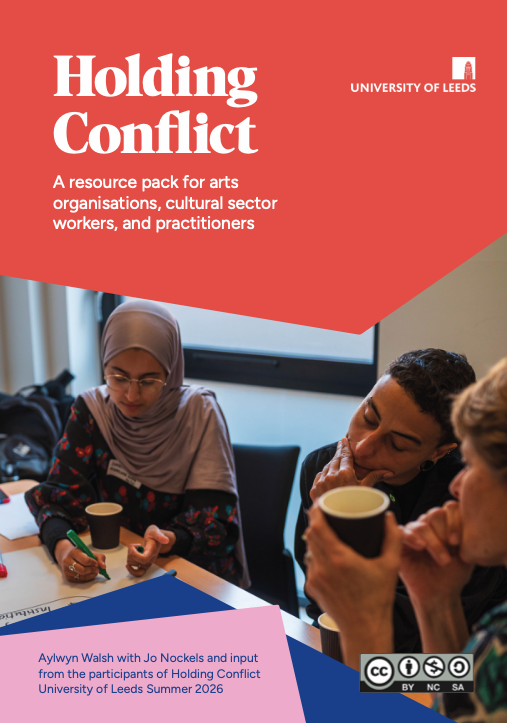
That second kind of crisis is the subject of Holding Conflict, a free resource pack from the University of Leeds Cultural Institute. Prof ally walsh wrote it with Jo Nockels, drawing on two workshops held in Leeds in 2026. The first was with Yorkshire Dance, Red Ladder Theatre Company, Yorkshire Contemporary and Leeds Playhouse; the second brought in 15 organisations from across the region. You can download the pack here.
The pack doesn’t try to settle the arguments of the moment. It starts from the view that conflict will come, and that organisations can build the capacity to hold it rather than avoid it or rush to shut it down. The authors set this approach out across six domains:
- values and position
- power, accountability and governance
- preparation
- communication and care
- wellbeing and aftercare
- learning
Each domain comes with practices and guiding questions. “If backlash happens publicly tomorrow, what do we do?” is one. “Who is carrying the emotional load right now?” is another.
Much of the pack is about rehearsal. As the section on preparation puts it, “Prepared organisations respond deliberately. Unprepared ones panic.” Its second activity, Interrupting Assumptions, is adapted from material by Suhaiymah Manzoor-Khan. It gives a team three scenarios:
- a programmed work on a politically sensitive issue that draws media criticism and a nervous funder;
- an exhibition accused by some of “rewriting history” and by others of not going far enough;
- an artist whose public statements put the organisation under pressure.
Participants take roles (a defender, two interrupters and an observer) and work the scenario through. They then debrief on what felt realistic, which assumptions came up, and when the conversation opened up or closed down. This is a type of tabletop exercise, and it is the method we use in the Culture Crisis Lab.
The pack also offers a seven-question “decision-making check under pressure”. It opens by asking whether everyone is clear about the actual issue, then asks who holds responsibility and who faces the risk. Dr Dani Abulhawa’s section on what to do when a complaint is made comes from her research on courageous programming. It includes a values check many boards will find useful: would we respond to this complaint in the same way if it targeted another marginalised community?
For trustees, the pack includes a short explainer from Adam Baker, a law lecturer at Leeds. He looks at why cultural charities so often read Charity Commission guidance as a bar on saying anything political. He says the law is widely seen as ambiguous, so organisations err on the side of caution. In fact, the Commission’s guidance on campaigning and political activity (CC9) allows more than its reputation suggests. A charity cannot have a political purpose, and it must not support or fund a political party. But any charity can campaign and take part in political activity that furthers or supports its charitable purposes. It can also comment publicly on social, economic, and political issues related to its purpose. The limit is that political activity must not become the charity’s continuing and sole activity. For most arts charities, the question is less whether they may speak than whether they make and record the decision properly. The pack’s governance domain deals with that.
The pack also ties conflict to the way cultural work is paid and organised. It cites the Freelancers Make Theatre Work Big Freelancer Survey 2025. That survey found that 44% of respondents earned less than the 2024 national living wage in the 2023-24 tax year, and that the average freelancer is unpaid for 36% of the hours they work. When so much of the sector runs on insecure work, disagreements over values are harder to absorb. As the pack points out, the weight often falls on front-of-house teams and stage managers.
Not every reader will share every position the authors take, and they acknowledge that the pack reflects one set of conversations in one region. Holding Conflict is generous, practical and well sourced, and its activities can be used straight off the page.
If you would like to rehearse this kind of situation with your own team, Culture Crisis Lab sessions are designed for it. The first is at Governance Now 2026 in Middlesbrough on 2 November. Sign up to hear about future dates, or get in touch at hello@culturecrisislab.uk.
Holding Conflict is published by the University of Leeds Cultural Institute under a Creative Commons BY-NC-SA 4.0 licence.